We are grafted into the House of Israel when we are baptized
Nov 07, 2025
The assassination of Charlie Kirk has sparked an intense divide between conservatives — apparently, it’s between those who shut down free speech in order to receive $7,000 from the State of Israel, and those who don’t, if Instagram comments are any indication. Many youth of today have been totally captured by the arguments of Candace Owens, Tucker Carlson, and Nick Fuentes, who argue that Israel controls the United States (to varying degrees).
This article will posit that because of the unique theological relationship Latter-day Saints have with the Jewish people according to our history and doctrine, we have no business falling for TikToks and reels that blame the Jews for all of our problems. While the Jewish people claim no formal relationship with the church and vice-versa, members of the church of Jesus Christ of Latter-day Saints believe that our modern-day prophets are a continuation of Old Testament prophets, and the same religion has existed since Adam. Here are four points of Latter-day Saint doctrine and history.
- Jerusalem is the land of the Jewish people’s inheritance
The belief that Jerusalem and the land of Israel belong to the Jewish people is also called Zionism. There is Latter-day Saint historical and doctrinal backing for Zionism.
Both Orson Hyde and Joseph Smith in dedicatory prayers blessed the land of Jerusalem for the Jewish people to inherit.
Orson Hyde was an apostle of the Lord and arrived in Jerusalem in 1841 to dedicate the land of Palestine by “apostolic authority” preparatory “to the return of the Jews and other of the tribes of Israel to that land of promise.” In his prayer, he blessed the land to be “possessed by its rightful heirs,” and consecrated the land unto God, “for the gathering together of Judah’s scattered remnants.”
Joseph Smith himself prayed that “the yoke of bondage may begin to be broken off from the house of David; and the children of Judah may begin to return to the lands which thou didst give to Abraham, their father.” This was in the dedicatory prayer to the Kirtland Temple, canonized in Latter-day Saint scripture, the Doctrine and Covenants, 109:63-64.
Because of the conflict going on in the lands currently, and criticism for how Israel is run as a secular state, many may believe these dedicatory prayers are outdated or no longer applicable. But the Lord can see from the beginning to the end, and the Old Testament is very clear about Jerusalem being the land of the Jewish people’s inheritance, consistent with the prayers from Orson Hyde and Joseph Smith. This land of inheritance is bonded by an everlasting covenant — no expiration date.
The land of Canaan was given to Abraham by covenant, which encompasses all the land of modern Israel today. God gave this land for Abraham to possess forever, “I will give unto thee…the land wherein thou art a stranger all the land of Canaan, for an everlasting possession.” (Genesis 17:5-8)
Today, the land of Israel is split up into three parts. The main part is called Israel. The eastern part is known as the “West Bank,” and is inhabited by Palestinians under Israeli rule. The Israelis often call the West Bank “Judea and Samaria,” while Palestinians often call it “Palestine.” The third part is the Gaza Strip on the west side next to the sea, which was under the jurisdiction of Hamas, but their influence remains contested after much conflict. These three parts combined are the ancient land of Canaan promised to Abraham in the Bible, as seen on the map below.
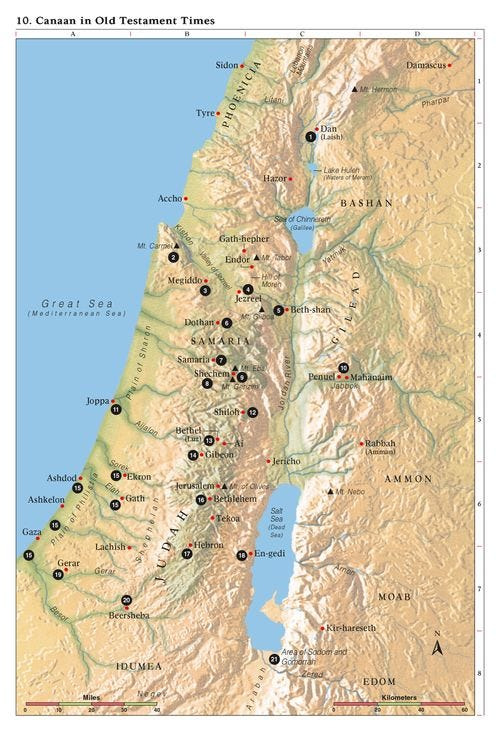
(Pictured: the land of Canaan in Old Testament times)
This land of promise was passed down through Isaac, Abraham’s son, who himself had had twelve sons, the twelve tribes of Israel. Many years after the twelve tribes of Israel were named, the ancient Israelites found themselves in Egypt under captivity by the Egyptians. Moses was then commanded by God to lead them out of Egypt to the land of their fathers; the land of Abraham, Isaac, and Jacob. “The Lord shall bring thee into the land of the Canaanites, as he sware unto thee, and to thy fathers and shall give it to thee.” (Exodus 13:11)
There are many other scriptures which point to this promise, such as Numbers 13:2, Numbers 14:8, Deuteronomy 1:8, and 1 Chronicles 16:15-18.
Former Jerusalem Center Director David B. Galbraith, a BYU in Provo professor emeritus of Middle East studies and conflict management spoke at a fireside in 2004 and reinforced these promises. As Latter-day Saints, we “should not feel apologetic to our Arab-Palestinian friends or to anyone who fails to see the divine purposes of the Lord in gathering the Jews.”
“This latter-day gathering is a doctrinal imperative. These last days have been called a dispensation of the gathering,” Galbraith said, citing Joseph Smith, “Judah must return, and Jerusalem must be rebuilt. All this must be done before the Son of Man can return.” Galbraith’s whole lecture can be found here, and contains excellent insights on how to deal with both the heated nature of the ongoing conflict in Israel and the doctrinal realities of the church of Jesus Christ.
- The historical “Jewish question”, determining where the Jew’s place was in the world, has also been raised with Latter-Day Saints.
Antisemitism is not a new concept, and anything but original. There is an exhaustive definition of antisemitism on the Department of State’s website, but broadly speaking, it means to hate the Jews. Hating the Jews is not a new thing to do, and today, many justify this hate by claiming the Jewish people rule the world with ill intent. Why is this tendency to hate so common? Some point to the “Jewish question”: how can certain societies integrate Jewish populations when they are such a “peculiar people”?
Jewish thinker Moses Mendelssohn, in response to this Jewish question, advocated for Jewish emancipation and cultural integration while maintaining religious identity. The Dreyfus Affair proved that Jews face hatred regardless of assimilation, and many antisemitic voices argue that because of the strict nature of Jewish religious practices and other concerns, they could never fully assimilate.
More than 50 years before the rise of Adolf Hitler German anti-semitism was on the rise. “The Jews tried everything to combat the poison,” Paul Johnson writes in Modern Times. “Some brought up their children to be artisans or farmers. They enlisted in the army. They attempted ultra-assimilation…But each policy raised more difficulties than it removed, for anti-Semitism was protean, hydra-headed, and impervious to logic or evidence.” (Modern Times, page 121)
Adolf Hitler, Heinrich Himmler, and Reinhard Heydrich answered the Jewish question with the “Final Solution” — extermination.
The Jewish people are resilient. They are God’s chosen people (Deuteronomy 7:6). They tend to group together. Wherever they go, they seem to find success.
“It is undoubtedly true to say that Weimar culture would have been quite different and infinitely poorer, without its Jewish element,” Paul Johnson writes again, “and there was certainly enough evidence to make a theory of Jewish cultural conspiracy seem plausible.” (Modern Times, page 117)
Most societies consider these attributes to be extremely threatening, adding to this “Jewish question”.
A somewhat similar question has been raised about Latter-Day Saints, especially in the early days of the church. There is absolutely no parallel between the early persecution of Latter-Day Saints and the centuries of horrors the Jewish people have faced, including the holocaust. But the violent persecution the saints faced during the restoration of the church presented the same tired old solution: Monitor them, kill them, and drive them from the country. Don’t let their successful families and business ventures take over society.
“In 1846 our people had to exodus from the United States because of the threat of annihilation,” prophet Ezra Taft Benson said. “We settled in a desert region similar to the topography around the Dead Sea and the Sea of Galilee. There we have developed our ‘land of promise.’”
- Latter-day Saints are sometimes swallowed up into the Jewish conspiracy
The holocaust museum in Washington DC houses an Anti-Masonic poster. The text at the bottom reads “Freemasonry is an international organization beholden to Jewry with the political goal of establishing Jewish domination through world-wide revolution.” The poster has a map, showing where each revolution took place in Europe from 1789 to 1919.
The leap from Freemasons to Latter-day Saints is not large. While the church tried to maintain a neutral position in Nazi Germany (unfortunately) and wasn’t a specific target of hate, Joseph Smith was a Freemason. The freemason connection is alive and well on X today: “Freemasonry is a Jewish organization with Ashkenazi origins and Talmudic beliefs.”
True to form, Candace Owens has suggested the assassination of Charlie Kirk is the Mormon’s fault. “Jokes on you if you think Turning Point USA is a Christian organization, it’s a Mormon one.” She proceeds to suggest the Mormons are in cahoots with Israel.
Lately, many have suggested Protestants in general are a part of this great Jewish conspiracy, and it’s only Catholics who are absolved from these crippling falsehoods.
- Latter-day Saints are grafted into the House of Israel when we are baptized
It’s become trendy to reject the “Judeo” part of “Judeo-Christian,” a term often used by some conservatives to describe the religious underpinnings of America’s founding.
“Christ is King” is now a popular phrase to suggest that Christianity is an isolated religion that relies on no other tradition or ideology. Jesus, having grown up in the land of Israel and in the Jewish tradition, is rejected in lieu of his divine calling which was to usher in the new covenant.
When each Latter-day Saint is baptized and confirmed they make their first covenant with God. This covenant connects them to a much larger and grander covenant which is the Abrahamic covenant. After being baptized each member of the church is encouraged to receive a Patriarchal Blessing in which each individual is spiritually grafted into the family and House of Israel.
As Latter-day Saints, we believe in the literal gathering of Israel and the restoration of the Ten tribes. (Article of Faith 10) Latter-day Saints embrace the Judeo part of Judeo-Christian, and view the Jewish religion as a direct part of our heritage, while still recognizing the Jews as a living community with their own self-understanding. For Latter-day Saints, the ancient law of Moses was not done away with, but fulfilled through modern covenants like baptism and promises made in the temple.
Rabbi Mark Diamond and BYU professor Shon Hopkins came together to write a book with the purpose of fostering respect and interfaith dialogue. They wrote Understanding our Jewish Neighbors. While they outline many differences between Latter-day Saints and Judaism in their book, (as the saying goes, “two Jews, three opinions”) “what we have in common is of far greater significance than that which divides us.”
“When we understand one another,” Ezra Taft Benson said, referring to Latter-day Saints and the Jews, “then perhaps you will understand why Ben-Gurion said, ‘There are no people in the world who understand the Jews like the Mormons.’”
Read on Substack here: https://ellamariedawson.substack.com/p/latter-day-saints-have-a-unique-kinship