- Joseph Smith, Wentworth Letter, 1942
- Joseph Smith letter to Noah C. Saxton, 1833
- Joseph Smith, conference minutes, 1834
- Joseph Smith, 1843
- Oliver Cowdery, 1834
- Brigham Young, 1845 from the Proclamation of the Twelve Apostles
- Brigham Young, 1854 speech
- Brigham Young, as told by George Q. Cannon, 1861
- Brigham Young; 1873 letter to George A. Smith
- Wilford Woodruff; 1879
- Orson F. Whitney; 1920 Oct. General Conference
- Heber J. Grant; 1921 April General Conference
- David O. McKay; 1921 November visit to the Holy Land
- Joseph Fielding Smith; 1922 in his Essentials in Church History
- 1959 Letter from First Presidency to stake and mission presidents
- Bruce R. McConkie, The Millennial Messiah
- Spencer W. Kimball, Dedication of the Orson Hyde Memorial, Oct. 24, 1979
[Quotes in red have been used on our Key Takeaways page.]
Joseph Smith in his Wentworth Letter, 1942 (becomes the 10th Article of Faith)
We believe in the literal gathering of Israel and in the restoration of the Ten Tribes.
Joseph Smith letter to Noah C. Saxton, January 4, 1833.
The Book of Mormon is a record of the forefathers of our western tribes of Indians, having been found through the ministration of an holy angel, translated into our own language by the gift and power of God, after having been hid up in the earth for the last fourteen hundred years, containing the word of God which was delivered unto them. By it, we learn that our western tribes of Indians are descendants from that Joseph that was sold into Egypt, and that the land of America is a promised land unto them, and unto it all the tribes of Israel will come with as many of the gentiles as shall comply with the requisitions of the new covenant.
But the tribe of Judah will return to old Jerusalem. The city of Zion, spoken of by David in the102nd Psalm, will be built upon the Land of America and the ransomed of the Lord shall return and come to it with songs and everlasting joy upon their heads, and then they will be delivered from the overflowing scourge that shall pass through the Land.
But Judah shall obtain deliverance at Jerusalem, see Joel 2:32; Isaiah 26:20-21; Jer. 31:12; Psalm 50:5; Ezekiel 34:11-13. These are testimonies that the good Shepherd will put forth his own sheep and lead them out from all nations where they have been scattered in a cloudy and dark day, to Zion and to Jerusalem beside many more testimonies which might be brought——
And now I am prepared to say, by the authority of Jesus Christ, that not many years shall pass away before the United States shall present such a scene of bloodshed as has not a parallel in the history of our nation: pestilence, hail, famine, and earthquake will sweep the wicked of this generation from off the face of this land to open and prepare the way for the return of the lost tribes of Israel from the north country—
The people of the Lord, those who have complied with the requisitions of the new covenant have already commenced gathering together to Zion which is in the state of Missouri.
Therefore I declare unto you the warning which the lord has commanded me to declare unto this generation, remembering that the eyes of my maker are upon me and that to Him I am accountable for every word I say, wishing nothing worse to my fellow men than their eternal salvation. Therefore fear God, and give glory to Him for the hour of His judgment is come. Repent ye, repent ye, and embrace the everlasting covenant and flee to Zion before the overflowing scourge overtakes you. For there are those now living upon the earth whose eyes shall not be closed in death until they see all these things which I have spoken fulfilled. Remember these things, call upon the Lord while He is near and seek Him while He may be found, is the exhortation of your unworthy servant,
~Joseph Smith Jr
Minutes of Conference, April 21, 1834
Norton, Medina County, Ohio, April 21, 1834.
This day a conference of Elders assembled at the dwelling house of Brother Carpenter. President Joseph Smith, Jun., read the second chapter of Joel’s prophecy, prayed, and addressed the conference as follows:
“It is very difficult for us to communicate to the churches all that God has revealed to us, in consequence of tradition; for we are differently situated from any other people that ever existed upon this earth; consequently those former revelations cannot be suited to our conditions; they were given to other people, who were before us; but in the last days, God was to call a remnant, in which was to be deliverance, as well as in Jerusalem and Zion. Now if God should give no more revelations, where will we find Zion and this remnant? The time is near when desolation is to cover the earth, and then God will have a place of deliverance in His remnant, and in Zion.”
The President then gave a revelation of obtaining and translating the Book of Mormon, the revelation of the Priesthood of Aaron, the organization of the Church in 1830, the revelation of the High Priesthood, and the gift of the Holy Ghost poured out upon the Church; and said: “Take away the Book of Mormon and the revelations, and where is our religion? We have none; for without Zion, and a place of deliverance, we must fall; because the time is near when the sun will be darkened, and the moon turn to blood, and the stars fall from heaven, and the earth reel to and fro. Then, if this is the case, and if we are not sanctified and gathered to the places God has appointed, with all our former professions and our great love for the Bible, we must fall. We cannot stand; we cannot be saved; for God will gather out His Saints from the Gentiles, and then comes desolation and destruction, and none can escape except the pure in heart who are gathered.”
Joseph Smith in his History of The Church, Vol. V. p. 337, 1943
Judah must return, Jerusalem must be rebuilt, and the temple, and water come out from under the temple, and the waters of the Dead Sea be healed. It will take some time to rebuild the walls of the city and the temple, etc.; and all this must be done before the Son of Man will make his appearance.
Oliver Cowdery, Oct. 1834 in the Latter-day Saints Messenger and Advocate,
We believe that God has set his hand the second time to recover the remnant of his people, Israel; and that the time is near when he will bring them from the four winds, with songs of everlasting joy, and reinstate them upon their own lands which he gave their fathers by covenant.
Council of the Twelve under the leadership of Brigham Young, “Proclamation of the Twelve Apostles of the Church of Jesus Christ of Latter-day Saints To All the Kings of the World.” 1845.
And we further testify that the Jews among all nations are hereby commanded, in the name of the Messiah, to prepare to return to Jerusalem in Palestine, and to rebuild that city and Temple unto the Lord.
And also to organize and establish their own political government, under their own rules, judges and governors, in that country.
For be it know unto them that we now hold the keys of the priesthood and kingdom which are soon to be restored unto them.
Therefore let them also repent, and prepare to obey the ordinances of God.
. . .
For be it known unto you, that the only salvation which remains for the Gentiles, is for them to be identified in the same covenant, and to worship at the same altar with Israel. In short, they must come to the same standard. For, there shall be one Lord, and his name one, and He shall be king over all the earth.
Brigham Young speech on December 3, 1854.
Jerusalem is not to be redeemed by the soft still voice of the preacher of the Gospel of peace. Why? Because they were once the blessed of the Lord, the chosen of the Lord, the promised seed. They were the people from among whom should spring the Messiah; and salvation could be found only through that tribe. The Messiah came through them, and they killed him; and they will be the last of all the seed of Abraham to have the privilege of receiving the New and Everlasting Covenant. You may hand out to them gold, you may feed and clothe them, but it is impossible to convert the Jews, until the Lord God Almighty does it.
Brigham Young, as told by George Q. Cannon, Journal of Discourses 1:138. 1861.
Today, gathering people into the church will allow the whole world to be a gathering place. When Joseph Smith first revealed the area where the Saints would gather, a woman in Canada asked him if Jackson County would be big enough to gather all the people. Brigham Young answered this questions by stating that, “Zion will extend, eventually, all over this earth. There will be no nook or corner upon the earth but what will be in Zion. It will all be Zion. . . . We are going to gather as many as we can, bless them, [and] give them their endowments.”
Brigham Young in letter to Elder George A. Smith, his second counselor. 1873.
When you get to the land of Palestine, we wish you to dedicate and consecrate that land to the Lord, that it may be blessed with fruitfulness, preparatory to the return of the Jews, in fulfilment of prophecy and the accomplishment of the purposes of our heavenly Father.
Wilford Woodruff; 1879, Millennial Star, vol. 41, p. 244.
I wish in this testimony to say that the time is not far distant when the rich men among the Jews will be called upon to use their abundant wealth to gather the dispersed of Judah, and purchase the ancient dwelling places of their fathers in and about Jerusalem, and rebuild the holy city and temple.
For the fullness of the Gentiles has come in, and the Lord has decreed that the Jews should be gathered from all the Gentile nations where they have been driven, into their own land, in fulfillment of the words of Moses their lawgiver. And this is the will of your great Elohim, O house of Judah, and whenever you shall be called upon to perform this work, the God of Israel will help you.
Orson Whitney; 1920 Oct. General Conference
My spirit is in perfect tune with the keynote struck for this conference. I believe in charity and forgiveness. I fully agree with the one who said: “He that judgeth a matter before he heareth it is not wise.” And we do not hear a matter by hearing one side of it. It is wrong to pass judgment before proof of guilt. The Prophet Joseph Smith was murdered while awaiting trial on a trumped up charge of which he had not been proved guilty, nor could he have been. He had surrendered for trial, but his plotting murderers declared: “The law cannot reach him, but powder and ball shall.” And they forthwith carried out their wicked threat. . . .
JUDAH TO RETURN
About two months before that little company of forty-one Saints crossed the Atlantic on the ship Britannia, a notable conference was held at Nauvoo, and two of the Apostles, Orson Hyde and John E. Page, were called to go to Palestine and bless that land, that its barrenness might depart and the way be opened for the restoration of the Jews. For be it remembered that the gathering of Israel includes the assembling of “the dispersed of Judah”—their return to their ancient homeland. America is the Land of Zion, and here the New Jerusalem will stand. But Christ’s kingdom will have two capitals, one in the Old World, one in the New; “for out of Zion shall go forth the law, and the word of the Lord from Jerusalem.”
ORSON HYDE IN PALESTINE
John E. Page faltered and fell by the way; but Orson Hyde accomplished his mission, though beset and hindered by many hardships and difficulties. It took him a year and a half to reach the goal for which he had set out. Finally, on the 24th day of October, 1841, from the summit of the Mount of Olives, overlooking Jerusalem, he offered to Jehovah, the God of Israel, a most fervent and eloquent prayer in behalf of his covenant people. He blessed the sterile land by the power of the holy apostleship, that it might become fruitful once more, and that Judah might repossess his ancient heritage.
Afterwards he predicted that the British nation would take an active part in the redemption of Palestine; a prophecy fulfilled at the close of the recent World War, when General Allenby, at the head of a British army, made his triumphal entry into Jerusalem.
LATER MISSIONS TO THE HOLY LAND
In the year 1872 a mission went from Salt Lake City to the Holy Land. President George A. Smith headed the party, which also included Lorenzo Snow, one of the Twelve Apostles, and his gifted sister, the poet, Eliza R. Snow. Upon reaching Palestine, President Smith duplicated the work done by Orson Hyde in 1841, dedicating the land for the return of the Jews and the rebuilding of Jerusalem. Other elders of the Church have since visited that once favored and yet to be glorified region. President Anthon H. Lund was there in 1898; and he likewise offered up an earnest prayer for the great consummation. All this because Moses restored the keys for the gathering of Israel in this dispensation.
President Heber J. Grant, General Conference, April, 1921.
Some of you may be familiar with the agitation that is going on at the present time, in the publications, against the Jewish people. There should be no ill-will, and I am sure there is none, in the heart of any true Latter-day Saint, toward the Jewish people. By the authority of the Holy Priesthood of God, that has again been restored to the earth, and by the ministration, under the direction of the Prophet of God, Apostles of the Lord Jesus Christ have been to the Holy Land and have dedicated that country for the return of the Jews; and we believe that in the due time of the Lord they shall be in the favor of God again. And let no Latter-day Saint be guilty of taking any part in any crusade against these people. I believe in no other part of the world is there as good a feeling in the hearts of mankind toward the Jewish people as among the Latter-day Saints.
David O. McKay, journal entry of his visit to the Holy Land in November, 1921.
When we parted from our guide last night, it was with the understanding that we should go to the Mount of Olives this morning; but we were surprised to learn first thing that the program was changed.
“Don’t ask me why I change,” said Michael, who seemed somewhat nervous, “just you trust me. I will tell you when we enter the city.”
Mr. Spiva and party were also disappointed in not finding their car ready to take them to the Dead Sea. We later learned that every driver was instructed not to run his auto, and that every Mohammedan and every Jewish business house and nearly every Christian place of business was closed for the day.
Said Michael: “This is a day of mourning; today the Mohammedans and Christians throughout Palestine unite in protesting against Lord Balfour’s declaration that Palestine shall be set apart as a gathering place for the Jews.”
This was revelation to me! At first I was inclined to treat the matter lightly, not crediting our man with a thorough understanding of the matter; but the more we questioned him and the more clearly we discerned his bitter antipathy towards the Jews, the more convince I became that we were going to witness this day a most significant demonstration.
Not a shop was open! Not a donkey or a camel did we see! Men and women were gathering in groups! We soon began to feel the spirit of tension in the city.
Michael was vehement — under his breath — in his protestations that the Jews shall never rule Palestine.
Said I, “Michael, standing here on the street of David, this 2nd of November, 1921, I was to tell you something to remember! No matter how much the Mohammedans and the Greek Christians oppose the Jews’ coming back to Palestine, the Jews are coming and will possess this land!”
“Never,” he cried with emphasis and bitterness, “The streets will flow with blood first!”
“The streets may and undoubtedly will flow with blood,” I answered, “but that will not prevent the Jews possessing their land. Don’t you believe your Bible?”
“I know the Bible says Jerusalem will be rebuilt,” was his admission, “but the time hasn’t come yet.”
“Yes, the time has come.”
. . .
By this time, 11:30 am, there was a good deal of Moslem rowdyism manifest in the narrow streets of the city, and our guide was so worried that his mind was more on what was going to happen than on what happened over 1900 years ago. And so was ours in a very few minutes! As we walked up David Street, we met hundreds of Mohammedans going toward the Mosque of Omar to pray. Suddenly behind them we heard imprecating yells and mingling with them cries for help. Hurrying forward, we saw two Jewish women, some children, and one or two men trying to escape from a mob with sticks and stones in their hands, pursuing them like hyenas after prey! I saw one fellow hurl a stone and strike a fugitive man in the back. The women’s faces were blanched with fear! . . .
The feeling in the street in which we now found ourselves was truly ominous. Recognizing us as Americans, the soldiers had permitted us to pass; but huddling groups of foreign Jews seems to eye us with suspicion. They were frightened but were consulting together and wondering what was going to happen. We tried in vain once or twice to talk to them, but none could understand English. Finally we approached a crowd in which a young man understood us, and whom we could understand. In reply to our question as to what the trouble was all about, he said: “The Mohammedans and Christians are opposed to the Zionist movement, and they make this demonstration as a protest against Lord Balfour’s declaration that Palestine should be given as a place for the Jews.”
We had asked and received answers to only a few questions, when the men whom we could see assembled in an arched hallway, ejaculated in what seemed to me to be protesting tones.
“Are they objecting to your talking to us?”
“Yes.”
“Well, tell them we’re Americans and favor the Jews coming back to Jerusalem. We’re Christians. . . .”
Later in the day, near the Damascus Gate, three Jews were killed — clubbed and stoned to death in reparation and vengeance! Wild rumors were afloat, and the tension was high, so it was difficult to obtain the real facts of the situation. Official orders were cried throughout the city that no one would be permitted on the streets after 5 o’clock p.m. And that order was implicitly carried out. At 6:00 p.m. the streets of Jerusalem were as deserted as a cemetery. Only the soldiers on guard and an occasional warning shot indicated the presence of the ominous spirit of the inhabitants of the Holy Land.
As I sat in my room thinking over the events of the day, only a hint of which I have here given, I was overwhelmed with the thought that we had witnessed on the 2nd of November the manifestation of a smouldering spirit of hatred which will some day in the near future cause much bloodshed!
Joseph Fielding Smith in his Essentials in Church History, p. 284.
It was Orson Hyde, who, in the life time of Joseph Smith, was intrusted with the important mission of dedicating the land of Palestine for the return of the Jews.
At the general conference of the Church held in Nauvoo, Hancock County, April 6–8, 1840, Elder Orson Hyde, who had not departed for England with the other apostles, was appointed to take a mission to Palestine to dedicate there the land for the gathering of the Jews. Elder John E. Page, who had also tarried at home, was called to accompany him. While addressing the congregation on the 6th, Elder Hyde remarked that it had been prophesied, some years before, that he had a great work to perform among the Jews; and that he had recently been moved by the Spirit of the Lord to visit that people, and gather all the information he could find respecting their movements, hopes and aspirations, and communicate them to the Church. He expressed the desire to visit the Jews in New York, London and Amsterdam, on his way to the field of his appointment. It was moved and carried that he proceed at once on his mission and that Elder John E. Page be given proper credentials and accompany him. On the 15th of April, Elder Hyde left Nauvoo for Jerusalem. Working his way across the country to New York, he sailed, after some delays, for Liverpool, on his way to Palestine, Saturday, February 13, 1841. He traveled alone, as Elder John E. Page had failed to make the journey.
March 2, 1959, the First Presidency issued a letter to stake presidents and stake mission presidents.
“We deem it wise to counsel stake missionaries, as well as other groups within the stake, not to foster or attempt to promote movements relating to the much mooted question: ‘Pro or Anti-Semitic.’
We think that generally speaking the Mormon people have understood the Jews, and have probably been more friendly to them than any other people, and with our concept of universal brotherhood it is untenable that we as a people should entertain prejudice and ill will against any of our Father’s children.
The projection of any issue of this character would in all probability be attended with misunderstandings and debate, and without substantial profit to anyone. We have a message for the Jews. We shall be most happy to give it to them if they will listen.
“In connection with the subject of this letter we take occasion to call the attention of our missionaries to the unwisdom of any attempt to set dates and times for the fulfillment of prophecy. … We accept the revelations, we believe in the prophecies. The time of fulfillment is in the unfathomable wisdom of the Lord. It is well to teach all people to be prepared for the fulfillment of prophecy, and leave all else to Him.”
Bruce R. McConkie, The Millennial Messiah, p. 229.
This starts out sounding like he’s denying that the Jews returning to Israel now is part of the gathering in scripture. Then he actually softens that view in the next paragraph, Make sure an read the entire quote. But there must be Jews who return to Israel so they are there at the Savior’s return to say to him, “What are these wounds in your hands?” Zech 13:6. If these Jews have already accepted the gospel, they will already know who He is.
As all the world knows, many Jews are now gathering to Palestine, where they have their own nation and way of worship, all without reference to a belief in Christ or an acceptance of the laws and ordinances of His everlasting gospel. Is this the latter-day gathering of the Jews of which the scriptures speak? No! It is not; let there be no misunderstanding in any discerning mind on this point. This gathering of the Jews to their homeland and their organization into a nation and a kingdom is not the gathering promised by the prophets. It does not fulfill the ancient promises. Those who have thus assembled have not gathered into the true Church and fold of their ancient Messiah. They have not received again the saving truths of that very gospel which blessed Moses their lawgiver, and Elijah their prophet, and Peter, James, and John, whom their fathers rejected.
This gathering of the unconverted to Palestine–shall we not call it a political gathering based on such understanding of the ancient word as those without the guidance of the Holy Spirit can attain, or shall we not call it a preliminary gathering brought to pass in the wisdom of Him who once was their God?–this gathering of those whose eyes are yet dimmed by scales of darkness and who have not yet become the delightsome people it is their destiny to be, is nonetheless part of the divine plan. It is Elias going before Messias; it is a preparatory work; it is the setting of the stage for the grand drama soon to be played on Olivet. A remnant of the once-chosen people must be at the proper place, at the appointed time, to fulfill that which aforetime has been promised relative to the return of the Crucified One. . . .
Spencer W. Kimball, Dedication of the Orson Hyde Memorial, Oct. 24, 1979
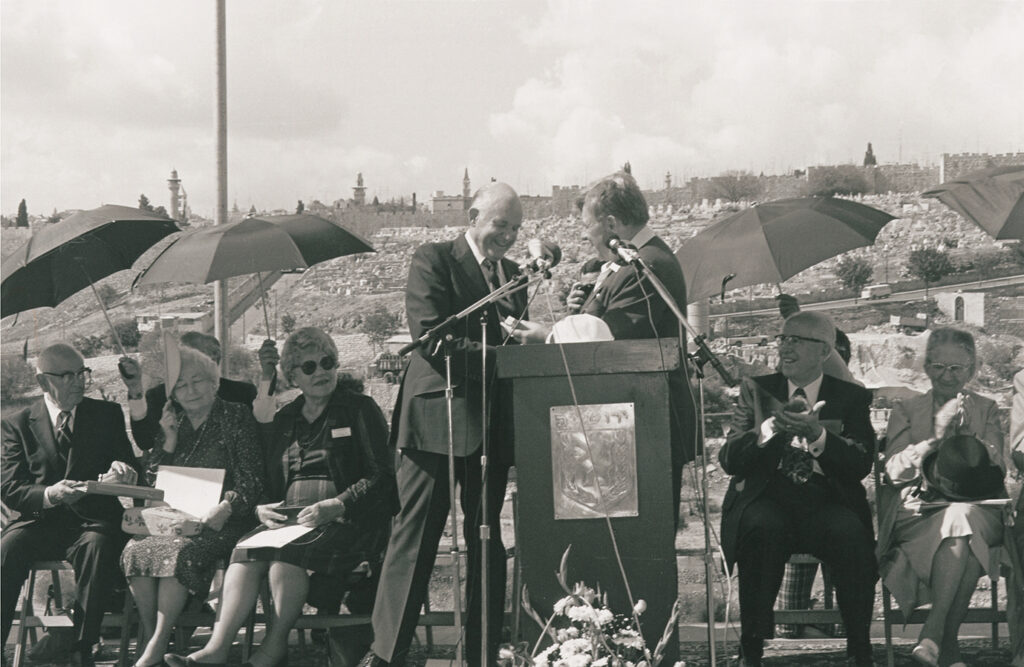
Part of the dedicatory prayer given by President Spencer W. Kimball:
Father, bless these grounds, these walks, these structures, the flowers, the shrubs and trees, that they may radiate the loveliness and give pleasure to those who visit here.
Protect this garden from the ravages of war and storm and depredation of every kind. Let it be a haven where all may meditate upon the glory which thou hast shed upon Jerusalem in ages past, and of the greater glory yet to be.
Let those who come here feel of thy Spirit and influence, and the spirit of the holy prophets who have traversed this beautiful land.
President Kimball also gave a speech in which he said that many parts of Elder Hyde’s prayer has been fulfilled.
The land has become abundantly fruitful again, with flocks and orchards and fields. The scattered children of Abraham have returned in great numbers to build up this land as a refuge, and the city of Jerusalem has flourished.
If a person could have had a vantage seat on this mount down through the ages, what scenes his eyes would have beheld.
From the mount, with the city of Jerusalem before him, a spectator through the centuries could have witnessed caravans of merchants and processions of armies and common folk from many nations and empires.